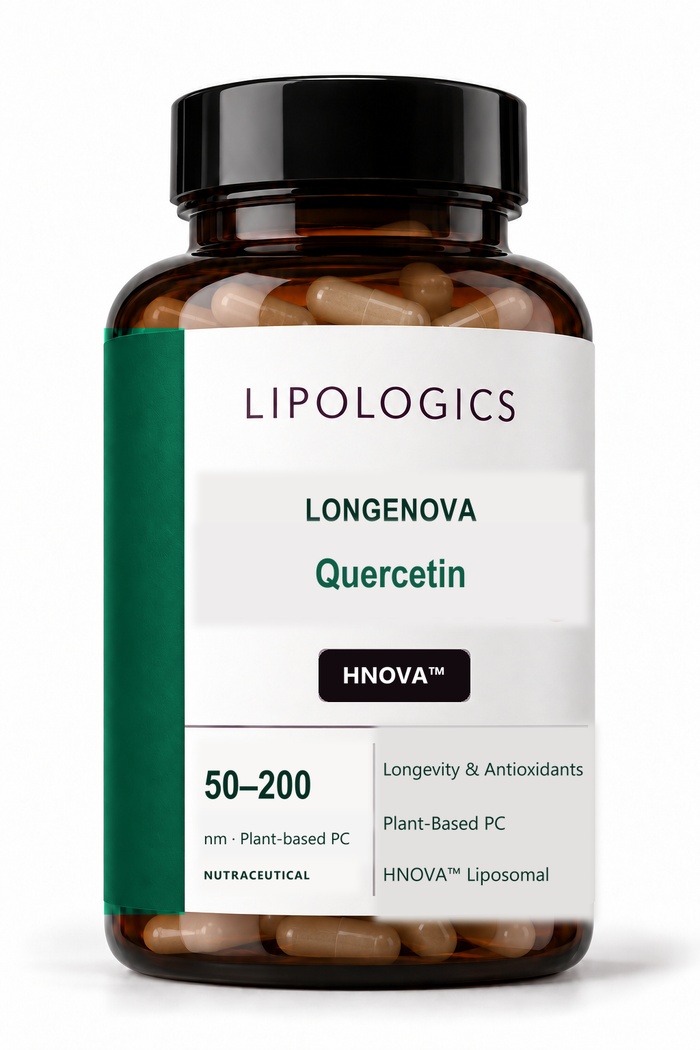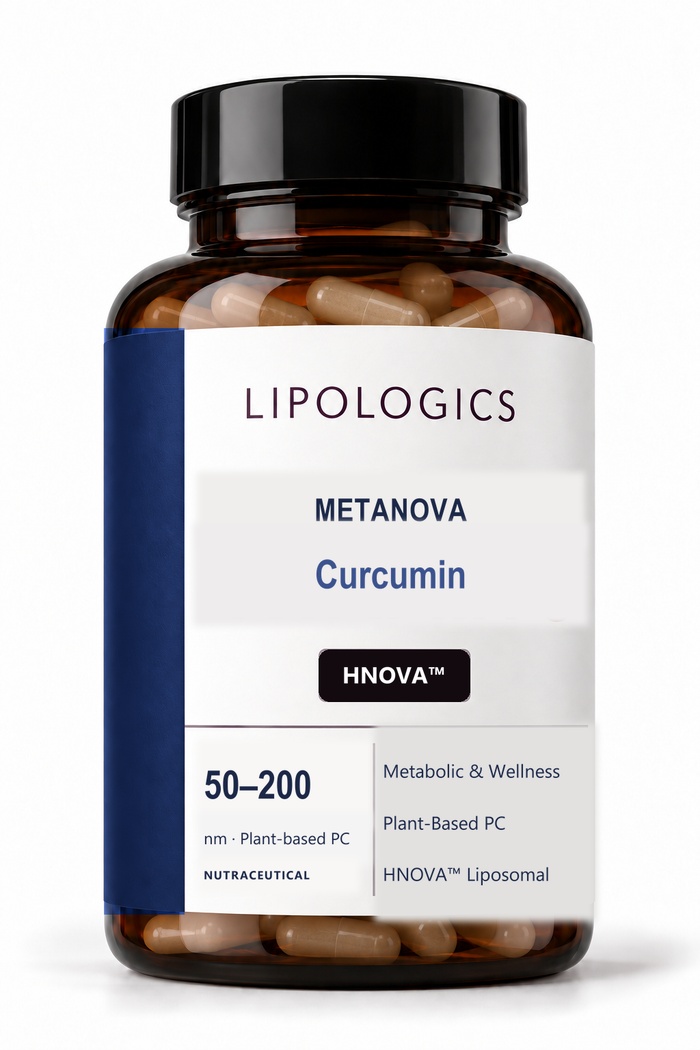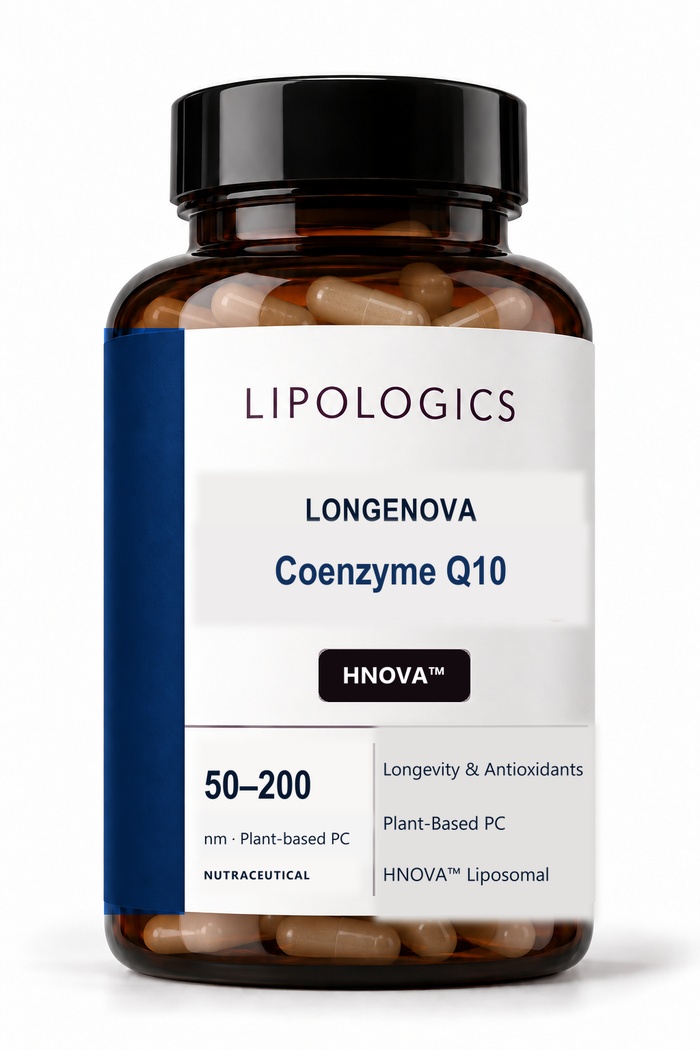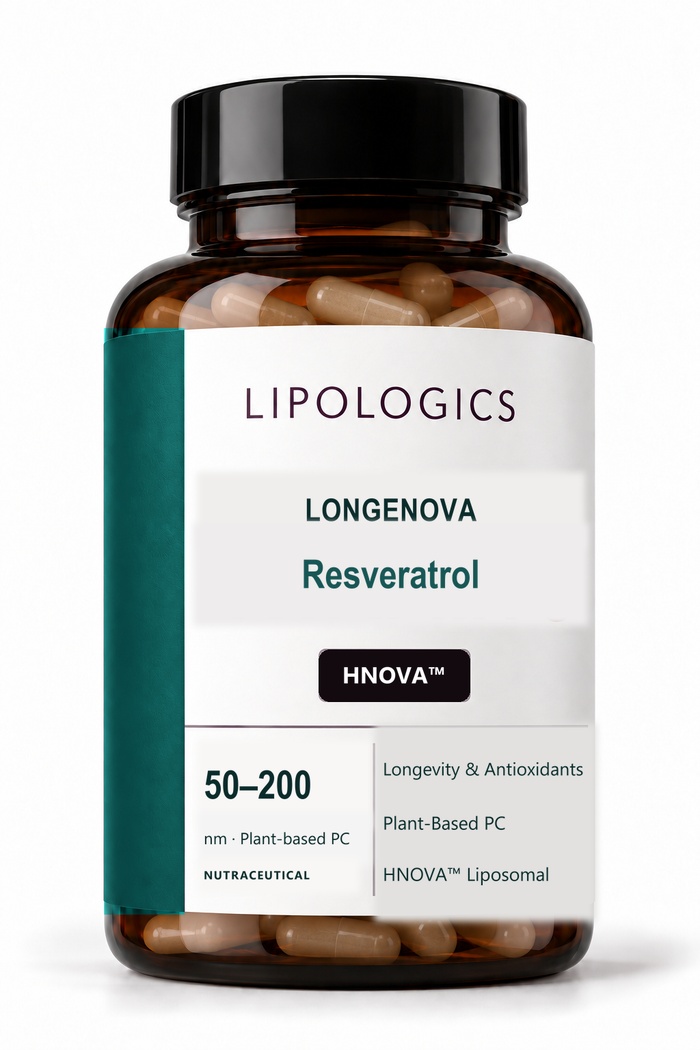
- Quercetin, curcumin, CoQ10, resveratrol and carotenoids are lipophilic and dissolve poorly in water.
- A liposome holds a lipophilic active in its phospholipid bilayer and a water-soluble active in its core.
- Carrier quality is measured by size, PDI, zeta potential and encapsulation efficiency.
- A liposomal format does not by itself prove better absorption — ask for ingredient-specific data.
The solubility problem
Many popular actives — flavonoids such as quercetin and fisetin, polyphenols such as curcumin and resveratrol, ubiquinone (CoQ10), and carotenoids such as lutein — are lipophilic. They dissolve poorly in water, tend to form crystals, and are sensitive to light, oxygen or pH. In a water-based product they can settle out or degrade; in the gut, poor dissolution can limit how much is available to be absorbed.
Formulators therefore look for a carrier that keeps the active dispersed, protects it, and presents it in a form the body can handle. Liposomes are one of the best-studied options.
How a liposome helps
A liposome is a spherical vesicle made from phospholipids — the same family of molecules that form cell membranes. The phospholipids arrange themselves in a bilayer around a small water-filled core.
- Lipophilic actives (quercetin, curcumin, CoQ10, lutein) sit inside the oily bilayer.
- Water-soluble actives (vitamin C, glutathione, some minerals) are held in the aqueous core.
- The bilayer shields the active from the surrounding medium, which can slow oxidation and keep the active dispersed in a liquid.
Because the vesicles are small — in a nano-liposome typically tens to a couple of hundred nanometres — the preparation can stay clear or lightly opalescent instead of cloudy, and can be dosed as a liquid, gel or capsule fill.
What to measure
| Parameter | What it tells you |
|---|---|
| Particle size | Average vesicle diameter; affects clarity, stability and handling |
| Polydispersity index (PDI) | How uniform the vesicles are; lower means a narrower distribution |
| Zeta potential | Surface charge; a guide to whether vesicles will repel or aggregate |
| Encapsulation efficiency | The share of the active that is actually inside the vesicles, not free in the liquid |
| Active loading | How much active is carried per unit of lipid |
| Stability over time | Whether size, content and encapsulation hold at the storage condition |
Each number should come with the method used. A size reported without PDI, or an encapsulation figure without a method, is hard to compare between suppliers.
Choosing a format
- Liquid or gel. The vesicles stay hydrated and ready to use; stability, pH and preservation need the most attention.
- Capsule fill. Convenient for dosing; check the fill is compatible with the capsule shell and the carrier lipid.
- Powder. Drying requires protectants to prevent vesicles fusing; ask for data on size after reconstitution.
Whichever you choose, the lipid source matters too. Plant-based phosphatidylcholine avoids egg and animal-derived inputs, which is relevant to allergen and labelling requirements.
What liposomes do not do
Liposomes are a delivery format, not a guarantee. How much of an active is absorbed still depends on the active itself, the dose, the formulation and the person taking it. Treat claims of a fixed multiple of improvement with caution unless they are backed by ingredient-specific data that matches your format and dose — and remember that nothing here is a statement about preventing or treating any condition.
What Lipologics provides
Lipologics supplies nano-liposomal ingredients on the HNOVA™ platform, developed and manufactured on Hoynoza's campus in Jigani, Bengaluru: plant-based phosphatidylcholine, 50 nm to under 200 nm vesicles, and 39+ actives across six brands, with per-ingredient specification sheets and Certificates of Analysis. See liposomal quercetin, liposomal curcumin, liposomal CoQ10 and liposomal resveratrol, or ask us for a specification.